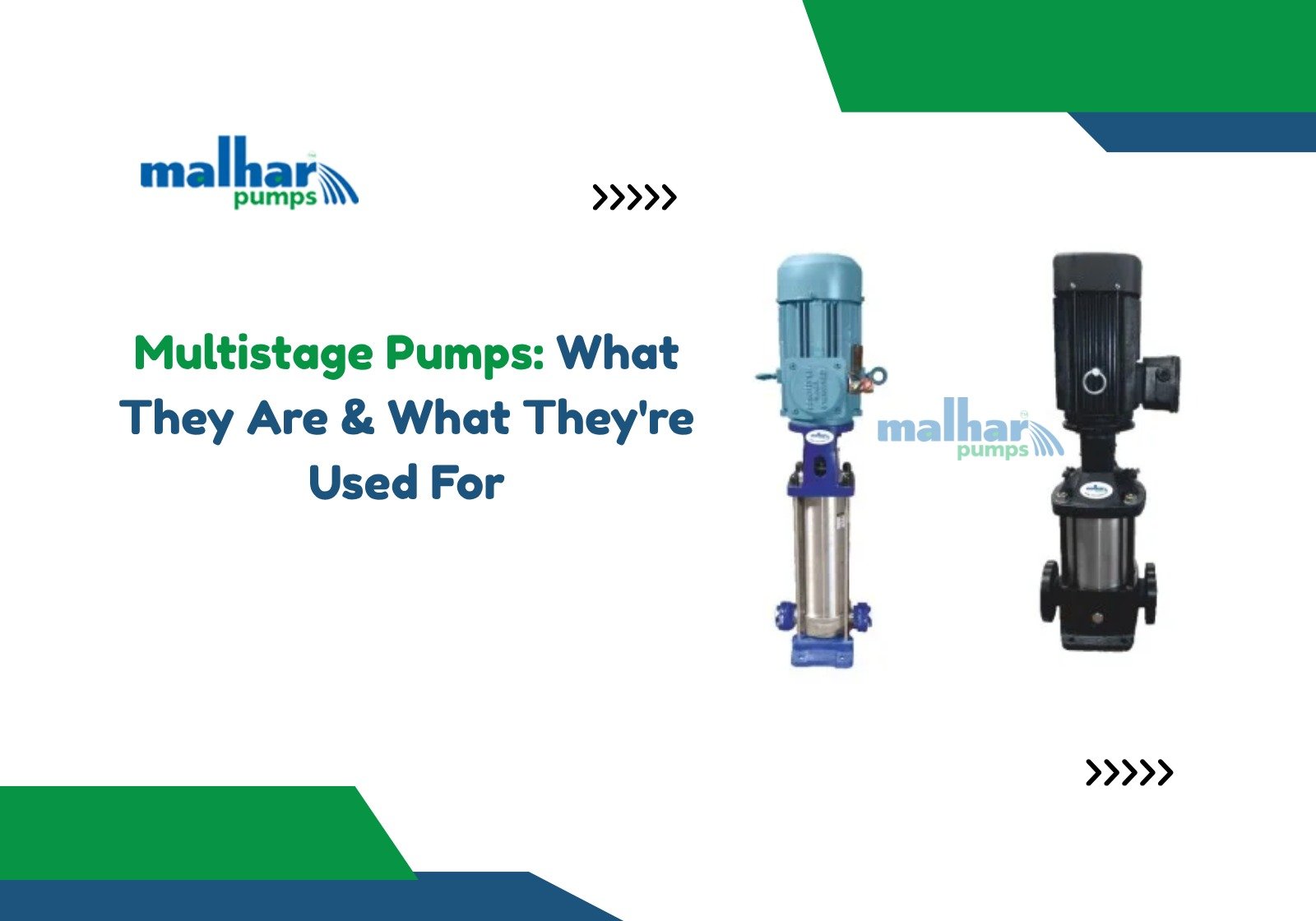


A multistage pump pushes fluid through two or more impellers set up one after another, and each stage adds a bit more pressure before passing the fluid along. That’s what makes multistage pumps the go-to option whenever a job calls for high pressure instead of just high flow – deep borewells and tall buildings being the two most obvious examples.
What Exactly Is a Multistage Pump?
A multistage pump packs several impellers into a single casing, all working one after the next. Each impeller nudges the fluid forward and adds a little more pressure before the next one takes over.
One impeller alone can only push so hard. Stacking stages together is simply the easiest way to reach higher pressure without needing a motor several sizes larger.
A few parts show up in almost every design:
- Several impellers mounted along one shaft
- Diffusers guiding fluid between stages
- One casing enclosing the entire stage sequence
- A single motor powering all the impellers at once
How Does a Multistage Pump Actually Work?
Fluid enters through the first impeller, picks up pressure, then passes through a diffuser into the second impeller, and this repeats until the final stage sends it out. Volume barely changes; pressure keeps building instead.
This staged buildup is really what separates a multistage pump from a single-stage one. Rather than asking one large impeller to do all the work, the load gets split across several smaller ones.
The payoff is a pump that reaches serious discharge pressure while using less energy at each stage than one oversized impeller ever could.
Where Do You Actually Find Multistage Pumps in Use?
Anywhere fluid has to travel a long way up, or needs pressure fast, is where multistage pumps tend to show up. Borewells and high-rise water systems are the two most common settings, but the list doesn’t stop there.
Common applications include:
- Deep borewell water extraction
- Water supply for multi-storey buildings
- Boiler feed systems in power plants
- Irrigation across large farmland
- Reverse osmosis and water treatment setups
What ties all of these together is one shared requirement: pressure that a single-stage pump just can’t produce on its own.
For reliable high-pressure water handling, explore Malhar Pump’s VILM Series Multistage Pumps, designed for efficient performance across demanding industrial applications.
Multistage Pump vs Single-Stage Pump: Which One Actually Fits Your Job?
A multistage pump suits high-pressure, lower-flow work, while a single-stage pump handles high-flow, low-pressure jobs better. Most of the decision comes down to what the site actually demands.
| Factor | Multistage Pump | Single-Stage Pump |
| Pressure output | High | Limited |
| Number of impellers | Two or more | One |
| Typical use case | Borewells, high-rise buildings | Shallow water transfer |
| Energy efficiency at high pressure | Better | Lower |
| Initial cost | Higher | Lower |
Get this choice wrong, and the result is either a pump burning more energy than it should, or one that simply falls short on pressure.
For high-pressure water pumping needs, you can also explore Malhar Pump’s RC Series Multistage Pumps and see if they fit your application.
What Should You Actually Look for in Multistage Pump Manufacturers?
A good place to start with multistage pump manufacturers is checking material certification, build consistency, and how much technical support they offer after installation. Skip this step, and pumps tend to fail sooner than they should.
Before settling on a supplier, it’s worth confirming:
- Material certification for impellers and casing
- Warranty coverage and after-sales service
- Manufacturing standards followed on the production line
- Prior experience with similar industrial or residential projects
Sticking with established multistage pump manufacturers also makes life easier later, since spare parts become far simpler to track down once the pump has been in service for a few years.
If you need a multistage pump for consistent water flow and pressure, take a look at Malhar Pump’s MKB Series to explore its features and applications.
How Should You Go About Choosing the Right Multistage Pump?
Picking the right multistage pump really comes down to three numbers: required pressure, flow rate, and how far the fluid needs to travel vertically. Get any of these wrong at the start, and the pump underperforms from day one.
Worth checking before buying:
- Total dynamic head the application demands
- Flow rate needed during peak hours
- Power source and voltage compatibility
- Available space for installation
Talking directly to multistage pump manufacturers before locking in a model is usually what prevents an expensive mismatch between what the pump can do and what the site actually needs.
Why Do Industries Keep Choosing Multistage Pumps Over Other Options?
Industries lean toward multistage pumps mainly because they hold high pressure reliably while staying more energy-efficient than an oversized single-stage alternative trying to do the same job. That balance between performance and running cost is hard to beat.
Space savings matter too. A handful of smaller impellers fit into a footprint that a single oversized impeller never could, which is exactly why multistage pumps work so well in cramped industrial and urban installations where every square foot counts.
FAQs
What is the main advantage of a multistage pump?
It builds far higher pressure than a single-stage pump by running multiple impellers together.
Are multistage pumps suitable for residential use?
Yes, many residential borewell and high-rise water systems depend on multistage pumps for adequate pressure.
How many stages does a typical multistage pump have?
It depends on the application, though two to ten stages is a common range.
Do multistage pumps need more maintenance than single-stage pumps?
Not by much, though regular servicing does help keep every stage performing well.
How do I choose between different multistage pump manufacturers?
Compare material certification, warranty terms, and after-sales support before making a final decision.
Follow Malhar Pump on Facebook and YouTube for the latest pump solutions, product updates, and industry insights.