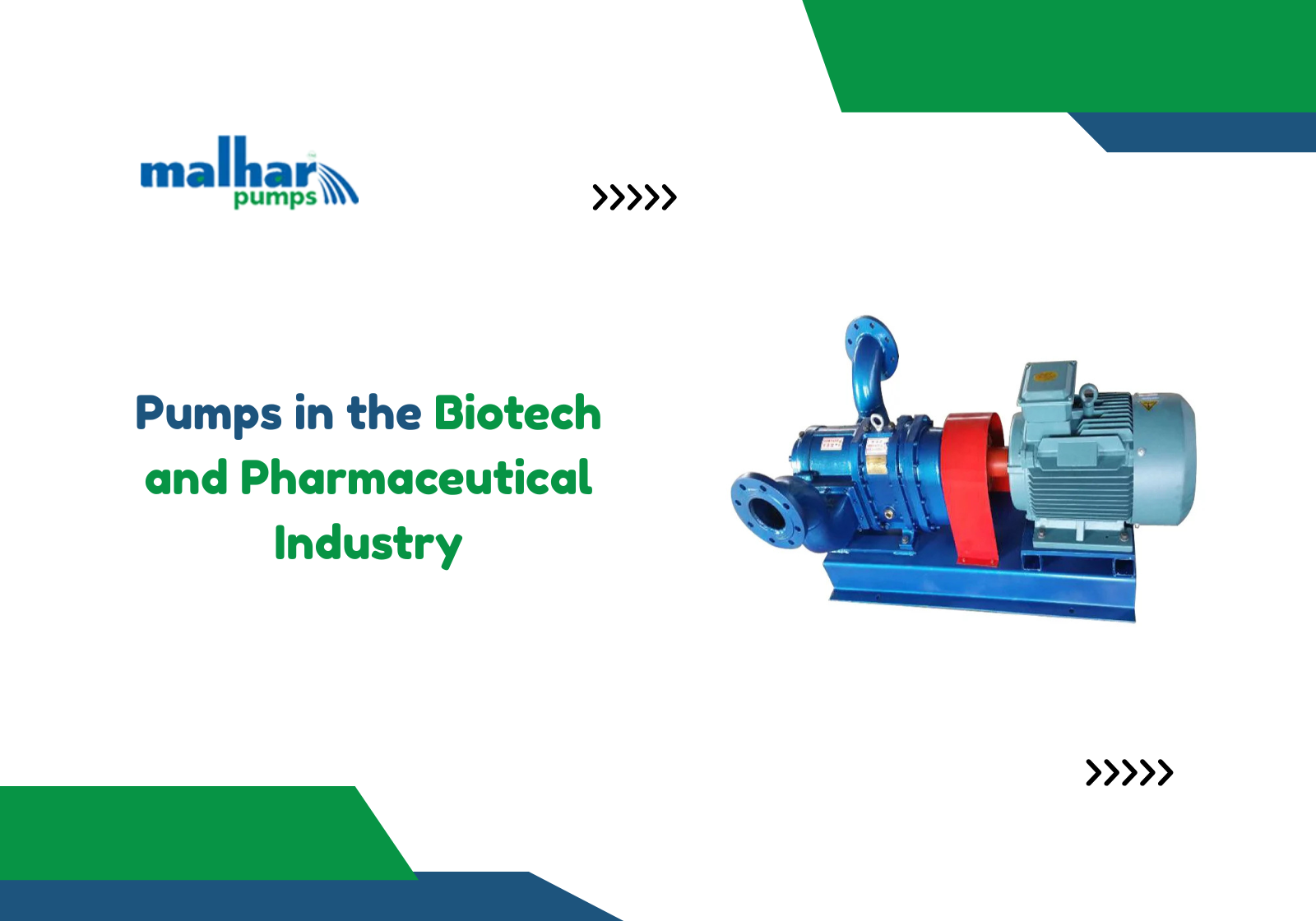


Pumps in the Biotech and Pharmaceutical Industry have to do something most industrial pumps never worry about: move fluid without changing it. A drop of contamination or a bit too much shear, and a batch that took weeks to grow can be unusable within minutes.
A cell culture batch nears completion in a bioreactor, ready to move to the next vessel. The transfer pump has a worn seal that nobody caught in time, and the batch gets flagged for contamination before it ever reaches formulation. This is exactly the kind of failure Pumps in the Biotech and Pharmaceutical Industry are designed to prevent.
What Are Pumps in the Biotech and Pharmaceutical Industry?
Pumps in the Biotech and Pharmaceutical Industry are purpose-built fluid transfer systems designed to handle sensitive biological and pharmaceutical liquids without compromising purity or product integrity.
General industrial pumps aren’t built with this in mind. Here, every design choice circles back to hygiene, gentle handling, and keeping the product completely isolated from anything that could contaminate it. A pump that looks fine on a spec sheet can still fail badly if it wasn’t actually built for this kind of work.
- Smooth, hygienic surfaces that resist microbial buildup
- Low-shear movement that protects fragile cells and proteins
- Pharma-grade materials approved for direct product contact
- Compatibility with sterilization and CIP/SIP cleaning cycles
Why Are Pumps in the Biotech and Pharmaceutical Industry So Critical?
Patient safety traces back, in part, to Pumps in the Biotech and Pharmaceutical Industry, since any failure during fluid transfer can directly compromise the final product.
Regulators, including the FDA and WHO-GMP, don’t treat pump selection as a minor equipment detail, they audit it closely. A pump that wasn’t validated properly, or one that missed a maintenance cycle, can end up being the reason an entire production batch gets pulled, and that cost adds up fast across both money and lost time.
How Do Pumps in the Biotech and Pharmaceutical Industry Work?
Gentle, controlled displacement is the operating principle behind most Pumps in the Biotech and Pharmaceutical Industry, rather than the high-speed centrifugal action common in general industrial pumps.
Peristaltic and diaphragm designs dominate this space because the fluid never actually touches a moving metal part; it stays inside a sealed tube or chamber the entire time. That separation keeps contamination risk low, even across long processing runs that stretch over several hours.
What Types of Pumps in the Biotech and Pharmaceutical Industry Are Common?
A few pump categories keep showing up across Pumps in the Biotech and Pharmaceutical Industry, each fitting a different stage of production.
The right choice depends mostly on how shear-sensitive the fluid is and how large the batch volume needs to be.
What Standards Apply to Pumps in the Biotech and Pharmaceutical Industry?
Strict compliance is non-negotiable for Pumps in the Biotech and Pharmaceutical Industry, with standards like ASME BPE, FDA material guidelines, and GMP validation shaping nearly every design decision.
- Internal surface finish must stay within set roughness limits
- Wetted parts need FDA or USP Class VI material approval
- Equipment must support both clean-in-place and sterilize-in-place cycles
- Full documentation and traceability are required for product-contact parts
How to Select the Right Pumps in the Biotech and Pharmaceutical Industry?
Selecting Pumps in the Biotech and Pharmaceutical Industry properly means working backward from the fluid itself, not forward from a catalogue listing.
- Determine how shear-sensitive the fluid actually is before anything else
- Verify wetted material compatibility with the specific product
- Confirm whether CIP/SIP cleaning is a requirement for the application
- Size, flow rate, and pressure around real batch volumes, not rounded estimates
Skipping this groundwork and choosing on price alone tends to backfire later, usually showing up as a failed validation during a regulatory audit.
What Maintenance Do Pumps in the Biotech and Pharmaceutical Industry Need?
Maintenance for Pumps in the Biotech and Pharmaceutical Industry has to be tracked carefully, since even small deviations can put regulatory compliance at risk, not just uptime.
- Inspect seals and diaphragms on a fixed schedule for wear or buildup
- Re-validate cleaning cycles periodically against actual contamination testing
- Keep maintenance records detailed enough to survive an audit
- Swap out wear parts ahead of failure rather than reacting after the fact
Manufacturers across India searching for dependable Pumps in the Biotech and Pharmaceutical Industry can count on Malhar Pump for hygienic, GMP-aligned solutions matched to actual process needs. More information is available at Malharpump.in.
FAQs
Why can’t standard industrial pumps be used in biotech or pharma production?
They aren’t built for hygiene or gentle handling, which puts sensitive fluids at contamination risk.
Which materials are typically used in these pumps?
Stainless steel and FDA-approved elastomers are the standard choice for product-contact surfaces.
Is a peristaltic pump a good fit for cell culture work?
Yes, its sealed flow path makes it well-suited for shear-sensitive fluid transfer.
Do biotech and pharma pumps need regulatory clearance?
Yes, compliance with standards like ASME BPE and FDA material approval is typically expected.
Where can these pumps be sourced within India?
Malhar Pump, available at Malharpump.in, supplies hygienic pump solutions built for biotech and pharma applications.
Explore our YouTube channel for insights into hygienic pump technologies, and stay connected on Facebook for the latest biotech and pharmaceutical pumping solutions.