
Let’s be honest, when it comes to moving water in industries, things never stay clean or simple. Many sectors deal with muddy or sludge-heavy water almost every day. And honestly, handling sludge is one of the most annoying tasks for any team. This is exactly why Floating Pumps for Sludge-Free Water Transfer have become the go-to option across industries.
If you’ve ever seen a floating pump working, you’ll know it looks almost effortless. It just sits on the surface, stays away from all the sludge drama and quietly transfers clean water from the top layer.
What Makes Floating Pumps for Sludge-Free Water Transfer So Useful?
Frankly, the biggest reason industries love Floating Pumps for Sludge-Free Water Transfer is that they automatically avoid sludge. These pumps float on the upper layer of water, which is always cleaner than what’s sitting at the bottom.
Because they stay above the sludge zone:
- They pull cleaner water
- They don’t get clogged easily
- They need less maintenance
- They last longer
Simple design, big advantage.
How Do Floating Pumps Actually Work?
By the way, floating pumps are much simpler than people imagine. The pump is mounted on a floating platform. Once placed on water, it stays on top and draws water from the clean surface layer. Since sludge settles at the bottom, the pump never touches it.
And honestly, that tiny design choice is the reason these pumps work so well for Floating Pumps for Sludge-Free Water Transfer in almost every industry.
Industries That Prefer Floating Pumps
Let’s be real—any sector dealing with large water bodies now uses floating pumps because they reduce headache and increase efficiency.
Common industries include:
- Mining and mineral processing
- Agriculture and irrigation
- Manufacturing plants
- Municipal bodies
- Chemical industries
- Wastewater management
- Construction sites
Wherever there’s a mix of water and sludge, floating pumps just make more sense.
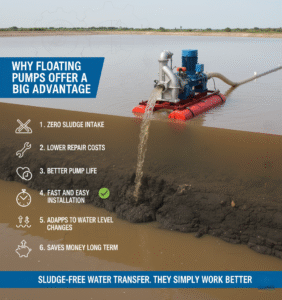
Why Floating Pumps Offer a Big Advantage
Let me break down the benefits without overcomplicating things.
1. Zero Sludge Intake
Since the pump never touches the bottom, it avoids sludge naturally.
2. Lower Repair Costs
No sludge means fewer blockages and fewer repairs.
3. Better Pump Life
The pump isn’t forced to handle dirt or solid particles every day.
4. Fast and Easy Installation
In fact, many teams install floating pumps in a few hours, without any specialised tools.
5. Adapts to Water Level Changes
Water goes up or down—the pump keeps floating and keeps working.
6. Saves Money Long Term
Less downtime, fewer repairs and longer life automatically reduce costs for the industry.
No wonder companies have shifted from traditional pumps to Floating Pumps for Sludge-Free Water Transfer because they simply work better.
Why Traditional Pumps Struggle
Traditional pumps sit deep at the base, which sounds okay until you remember that the bottom is where all the sludge collects. Mud, sand, silt—everything waits there.
Once a base pump starts pulling that mess:
- It clogs
- It overheats
- It breaks down
- It needs constant servicing
Honestly, it’s a never-ending cycle of trouble.
Floating pumps avoid the problem from the start.
A Real-World Example
Imagine a large factory reservoir.
The top layer looks normal, but the bottom has thick sludge.
A standard pump pulls everything-including sludge-and fails within days.
But a floating pump?
It stays above the sludge and keeps drawing clean water without stopping. No choking. No downtime.
That’s exactly why industries choose Floating Pumps for Sludge-Free Water Transfer today.
How to Choose the Right Floating Pump
Choosing one isn’t complicated, but you should check:
- Water quality
- Flow requirement
- The distance you need to transfer water
- Reservoir size
- Motor type and power
A little planning makes everything smoother later.
Final Thoughts on Floating Pumps for Sludge-Free Water Transfer
When you look at all the benefits, it’s easy to see why industries prefer Floating Pumps for Sludge-Free Water Transfer. These pumps are practical, smart and reduce a lot of everyday problems. Instead of constantly fighting with sludge, teams can focus on real tasks.
Floating pumps aren’t just a trend-they’re a long-term solution that saves time, money, and effort. Buy now!
FAQs
- Why do floating pumps avoid sludge so easily?
Because they stay on the top layer where the water is cleanest. - Are floating pumps hard to install?
Not at all. Most setups finish within a few hours. - Do floating pumps work in low water levels?
Yes, they adjust automatically as the water level changes. - Are they better than regular pumps?
For sludge-heavy water, absolutely yes. - Do floating pumps reduce maintenance?
Big time. Less sludge means fewer breakdowns and fewer repairs.
Follow us on Facebook for more industrial insights and tech updates.
Subscribe to our YouTube channel for the latest industrial guides, tech insights, and how-to videos.